
What's in a Legacy?
On Simone Forti -- and the other guy who died last week

Last week, on July 29, an artist I greatly admired died. It’s probably not the one you’re thinking of.
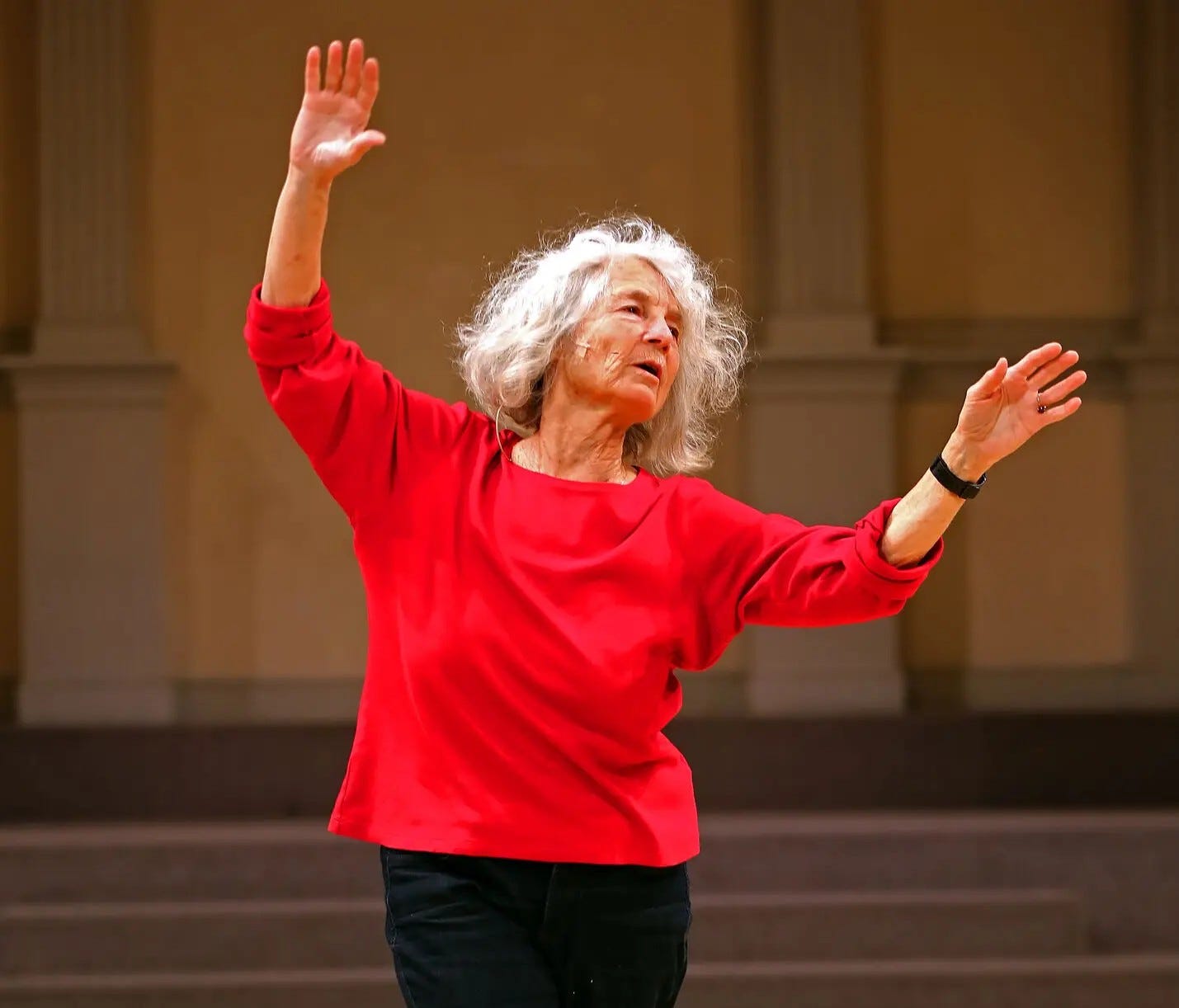
Simone Forti — dancer, choreographer, artist, writer — died in Los Angeles at 91. A pioneer of postmodern dance, Forti began performing her experimental “Dance Constructions” in the early 60s, at Yoko Ono’s NYC loft. She worked with La Monte Young and Claes Oldenberg, and while she was never a member of the Judson Dance Theater, her influence on the work of contemporaries like Yvonne Rainer and Trisha Brown is widely acknowledged. She was a joyous improviser, fond of prompts and props, and of exploding conventional ideas of what dance could be.
I first learned of Forti in a dance history class at Oberlin in 1989, when I was trying to figure out what dance meant to me and whether or not there was a place for me under its umbrella. Forti’s 1974 Handbook in Motion, a gentle manifesto/creative memoir/illustrated guide to her early work, was a class text. I had flunked freshman year art history, and knew little to nothing about the postwar avant garde of any discipline, but I was so taken with it, with her, and with what I intuited to be her playful spirit. Her work is loose and chancy, grounded in trust — like her signature work “Huddle,” for which dancers are instructed to stand very close together, arms around each others’ shoulders, and then climb up and over each other. “It is not necessary to know who is to climb next,” she wrote. '“Everyone in the huddle knows when anyone has decided to be next. Sometimes two are climbing at once. That’s OK.”
She studied with Martha Graham and Merce Cunningham for a time, but chafed against the restrictions of modern dance technique. “I could not hold my stomach in. I would not hold my stomach in,” she wrote in Handbook in Motion, of her time with Graham. Instead, she started teaching nursery school, and became fascinated with the holistic movement explorations of small children. She was in conversation with a lot of the minimalist artists of the era, with their interest in everyday objects and sounds, but her object of study was the everyday movement of the body — and not just the human body. After moving to Rome in the late 60s she devised her “Zoo Mantras” (aka “Sleep Walkers”), drawing on her close observation of animals in captivity at the Rome zoo.
“I gradually became aware that every time I went to the zoo, at some point during the day, I would catch sight of an animal doing a dance. It wouldn’t be the beauty of movement that would make me say that I was watching dancing, but rather the inner attitude of the animal,” she wrote. “The sea lions were having great fun. They were really doing movement play, which as far as I’m concerned is one of the roots of dance.” You can watch her performing and discussing “Zoo Mantras” in 2016, at the International Studio and Curatorial Program loft in Brooklyn, here.
I did not go on to become a postmodern dance star, but Ann Cooper Albright, then in her first year of teaching that Oberlin class, did go on to write the definitive book on Forti, 2024’s Improvising a Life. “For Forti, improvisation was more than just a dance form, or even a performance form,” she writes, “it was, rather, a life practice — a way of being in the world.”
Her way of being in the world was risky, but not without reward. While later in life she was diagnosed with Parkinsons, she continued to dance, write, and teach into her 80s, and had a retrospective at Los Angeles MOCA in 2023, the same year she was honored at the Venice Biennale. Her influence continues to be felt today at the intersection of dance, performance, and art (MOMA now holds the rights to “Dance Constructions”). Her obituary in the New York Times, however, has as of today garnered just 17 comments, including one from this insightful dance critic, who observed
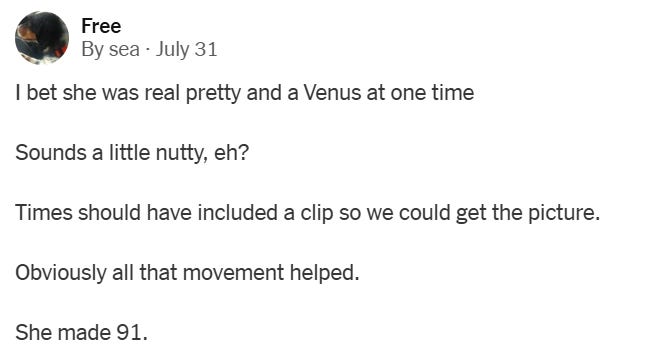
When I read this I sighed. Typical. Just another loser reducing a dancer to her youth and beauty; her artistic vision — a vision that couldn’t even be bothered to engage the male gaze — to “nuttiness.” But over the past few days it’s pissed me off more and more. Disproportionate, I know, to the import of one stupid, sexist comment, but here’s why.
Ready for the pivot?
…
I wasn’t going to write about Glen Hansard, the Irish musician who died the same day as Forti, coming home from the pub at 4 am on his motorcycle. “Stay in your lane, Martha,” I said to myself. But then I realized this actually was my lane? So here we are.
I was not a huge fan but I was aware of his work and I met him once during a period when he was regularly out and about in Chicago in the 2000s. When I heard that he had died, I thought, “Oh dear, that’s too bad. How horrible for his family,” and went on with my day. But as that day rolled on I became sort of confused by the outpouring of love I was seeing online. Did everyone else in the world really feel so passionately about this artist who made only a vague impression on me? Am I uncool? Out of it? And, wait, what were these other small things I was hearing bubbling up? The whisper network, still at whisper volume, but persistent, nagging at my ear.
And then, in quick succession, Neko Case and Irish writer Rosemary Mac Cabe posted fierce ripostes to the onslaught of adoring eulogies, and it snapped into place. Oh. Right. He was that guy. The guy in the scene you learn to stay away from. The guy whose charisma may grant him a pass on bad behavior that would get others less talented, less confident, and just plain less male in hot water. The humanitarian whose legitimate good works may also act as benevolent wallpaper to less savory behaviors.
His reputation for creeping on young women and teens is being called an “open secret,” at least in certain circles, and that’s not even getting into the Swell Season of it. It’s the kind of behavior that I’d like to think Sinead O’Connor (my lane), champion of women and children and truth teller on music industry sleaze, would never have countenanced. Yet the internet tells me they were friends, and I don’t doubt it. Ireland is a small country; its circle of internationally known middle-aged musicians even smaller. What does “friendship” mean in a sphere where celebrities collab and play at each others’ benefit concerts? I don’t know. I don’t quite know what to think about any of it, truthfully. But I know enough to know that, way over here in the U.S., I don’t have the slightest clue, so I respect and defer to the experience of a musician who shared a stage with him and a journalist who says she knows the score.
I also know well the feeling of powerless rage when a man you know to be a shitheel gets hailed as a hero, a genius, a savior. Gets a sendoff from Bono at St. Patrick’s Cathedral. Maybe you know it firsthand, in your everyday life. Maybe you know it because the global evidence is so overwhelming you have to plug your ears to tune out the drumbeat of disdain just to get through said life. Because they get the power, and they get the money, and the pain of women and girls is beneath notice, acceptable collateral damage. Weinstein. Epstein. Plattner. Trump. Cosby. Kelly. Diddy. Ryan Adams. Ken Stringfellow. Neil Gaiman. Jared Leto. I can’t even go on but you probably can, because you know all their names because they’re the ones with the fame, while the girls remain in shadow. But, just for the record, a person can be a beloved artist to millions and also have been shitty to some hundreds. This guy says so too! If said person is someone who’s been publicly celebrated as god’s gift over the years, it’s not far fetched to for them to eventually believe their own hype. To believe themselves invincible.
Simone Forti shunned the pretense of performance and preferred to share her work in intimate settings, in workshops and in galleries. She died after a rich, long, and well-lived life. Her legacy lives on in her body of work and in the thousands of young artists she taught and inspired. His fans would say the same of Hansard, who liked to busk and play in pubs, and built a successful career off his image as a man of the streets. He was known for lifting up younger artists (to an at times eyebrow raising degree). His life was cut short, in circumstances still under investigation. But one of them has 16 nice comments and one sexist one on her NYT obit. The other’s funeral is front page news, and the voices piping up to protest his lionization are being shot down as bitter, un-credible, and tacky.
It’s probably a stretch to pair an experimental dancer and an Oscar-winning musician in the same Substack ramble. But this is my lane because, in addition to being on the dead-Irish-folk-star beat, I’m also of late deeply engaged in trying to understand the ways I navigated this binary in my youth, and even today. Some days it feels like I’m still trying to understand why men and their guitars are lifted to the stars while so many women spend their pink-ghetto careers in the margins.
Haven’t figured it out yet! But if Forti’s obit can be made to stand with one shitty comment attached in perpetuity, Hansard’s legacy can sure stand to be complicated by the voices now speaking out of the shadows.
If this is interesting to you, you can read more here:


Martha, this is so good.
Thank you, Neko and Martha for writing so well about this. It’s maddening. Be brave enough to listen.