
Contract, Release
Messages from Martha Graham

“The Martha Graham Dance Company regrets that we are unable to perform at the Kennedy Center in April.”
With this brief January 16 announcement the Graham Company became the latest in a cascade of artists and arts organizations – from Bela Fleck to Issa Rae, Hamilton to the Washington National Opera – to decide that the costs of a cancelled gig are worth it if it keeps the stench of the Trump administration at bay.
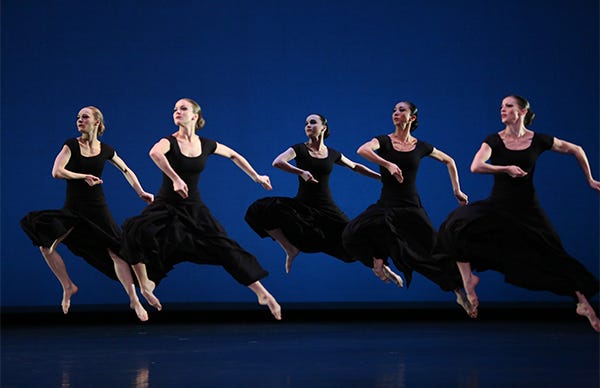
The four-night run at the Kennedy Center has presumably been on the books for a while, one of a handful of multinight engagements on an international tour that is taking the company to Italy, Latvia, and Cleveland in celebration of its 100th anniversary, a remarkable achievement for any arts organization let alone one dedicated to cryptic, mythic modern dance. I have to imagine that at one point the company was looking forward to performing on the Kennedy Center stage. One of the works on the centennial program is En Masse, a new piece by Hope Boykin, the former Kennedy Center Artistic Adviser for Dance Education, set to Leonard Bernstein’s Mass, a work commissioned by Jackie Kennedy (with choreography by Alvin Ailey) for the inaugural 1971 gala at the center that bore her murdered husband’s name.
That return, with all its resonance, is not happening – and the reason can be found embedded in another work in the centennial repertoire, the antiwar epic Chronicle, which Graham created in 1936 in response to the rise of fascism in Europe. From the Graham website: “Chronicle does not attempt to show the actualities of war; rather does it, by evoking war’s images, set forth the fateful prelude to war, portray the devastation of spirit which it leaves in its wake, and suggest an answer.” Danced by an all-female cast, just 16 years after women secured the right to vote in the United States, the hourlong work was hailed as a rare vehicle for female political expression and empowerment, and a call to rise up and fight back against oppression. You can watch a few snippets here.
That same year, the company was invited to perform at the Berlin Olympics, an invitation Graham famously declined. Ninety years later, her words are alarmingly of the moment. She wrote:
“I would find it impossible to dance in Germany at the present time. So many artists whom I respect and admire have been persecuted, have been deprived of the right to work for ridiculous and unsatisfactory reasons, that I should consider it impossible to identify myself, by accepting your invitation, with the regime that has made such things possible. In addition, some of my concert group would not be welcomed in Germany.”
I’ve never seen the Graham Company in person. The group performs Chronicle and En Masse, along with 1948’s Diversion of Angels, in Chicago on Saturday, January 24, but I can’t go, as I’m currently out of town. So earlier this week, in a fit of frustration, I pulled up the tour schedule to see if I might be able to make a field trip and write it off as research. Pittsburgh and Cleveland aren’t an option, and I don’t think I can make it to New York, where they’re at City Center for five whole nights, either. But the company performs February 7 in Minneapolis. Chronicle and En Masse are on the bill, as is Appalachian Spring. Graham’s 1944 classic, set to Aaron Copland’s Pulitzer-winning work built around the Shaker hymn “Simple Gifts,” evokes a sense of community resilience and postwar possibility. In this story of a frontier couple meeting and overcoming hardship to build a life together Graham used traditional motifs – religion, populism, the pioneer spirit – as cover to deliver a bundle of pacifist lefty messaging. To see the three performed in a city inflamed by injustice, powered by fury at the murder of an innocent woman, modeling resistance … it’s so on the nose I might have to go bear witness.
Ugh, it’s so stupid to write right now. There is so much misinformation and propaganda, so many hateful words, such a flood of lies that it feels immoral to pollute the infosphere with anything beyond establishible facts – and those are so hard to nail down with any confidence. How many kids did Renee Good have? Was she married? Does being on the school board make you political? What credentials permit the media to take the “so-called” away from “poet”? At what point does “fucking bitch” constitute a hate crime? Is there a way to figure it all out without watching snuff films??? I can see the holes and misdirection, because you can take the jobs away from the journalist but you’re stuck with the bullshit meter for life. But it’s also not my day job now and it’s too much to do right by after hours and so I am defeated.
But here’s a nice piece from the Chicago Reader, on the Graham Company at 100. Also: did you know that Isamu Noguchi, sculptor and set designer for Appalachian Spring, self-incarcerated at an internment camp during the Second World War? He went on to be a lifelong antifascist, antiracist activist, was investigated by the FBI, and was awarded the National Medal of Arts. The Japanese-American dancer Yuriko was incarcerated too. She joined the Graham Company after she was released in 1943, and danced in the premiere of Appalachian Spring. She danced with Graham for decades and then taught and restaged her works when she could no longer dance them herself. She lived to be 102.
After Graham’s own passing in 1991, at 96, the company she founded almost died as well, brought down by a leadership crisis instigated by an unqualified man (honestly a fascinating saga that I won’t get into here). For more than a decade, the company limped along, hemorrhaging dancers, reputation, and money, until new artistic director Janet Eiber took charge, and the company was reborn, creating new works, teaching new students, and returning Graham’s legacy to the international stage.
Rather than write, I spent this past weekend in a three-day dance workshop, the launch of the next iteration of Visceral Encore, the dance program for “older dancers” that I’ve been part of for the last two years. I also turned 58, and on my birthday (Saturday) I left the workshop early to perform in a circus show for the first time since I was diagnosed with cancer in 2022. Since then, between treatment, two broken bones, and seemingly endless rounds of rehab, it’s been hard to train. I’ve been trying to regain the upper body strength I had three years ago, but that clearly isn’t going to happen without a level of discipline that is beyond me. I also moved an hour away from my beloved circus gym and the commute to the city is a giant pain. But still, there I was: rickety, but flying again. It was so good to be back.
I have to keep believing in the capacity to rebuild this muscle, just as I have to keep believing it’s important to make this space for joy and beauty. The fundamental element of Graham technique is the cycle of contraction and release. It is an expression of breathing, the life force, and a metaphor for conflict and resolution, oppression and liberation. I have to believe this is fact as well — that we have the collective ability to flex our bodies in contraction, whistles blaring, so that there might come the release of an Appalachian Spring.
Your essays are helping me wrap my head around dance as both personal and political, a new way of understanding it for me. Thank you. I just turned 55 last week, and after treatment I too am learning the limitations age + cancer can put on a body. And yet, I'm out there hiking again every week, one hill at a time. Dorothy Day used to describe social change as one brick at a time; maybe it's one muscle at a time too.
I love this: “I have to keep believing in the capacity to rebuild this muscle, just as I have to keep believing it’s important to make this space for joy and beauty. The fundamental element of Graham technique is the cycle of contraction and release. It is an expression of breathing, the life force, and a metaphor for conflict and resolution, oppression and liberation. I have to believe this is fact as well — that we have the collective ability to flex our bodies in contraction, whistles blaring, so that there might come the release of an Appalachian Spring.”… thank you 🤍🤍